
Floorplan, Manu Exhibition,
Finnish Academy of Fine Art Gallery,
Helsinki Finland, 2010.
Finnish Academy of Fine Art Gallery,
Helsinki Finland, 2010.
“Naomi Lethbridge shows a lot in her drawings, especially that which is not shown. Antony Clarkson shows through everyday elements how the normal everyday can be beautiful in an installation. And so does Sean Green with her pretty organic and conceptual works - even in trying to avoid too much extra thinking. Clara Casian with her sculptures and animation shows how a simple idea can give a lot.” Petri Hytönen, 'Manu' Exhibition Catalogue.
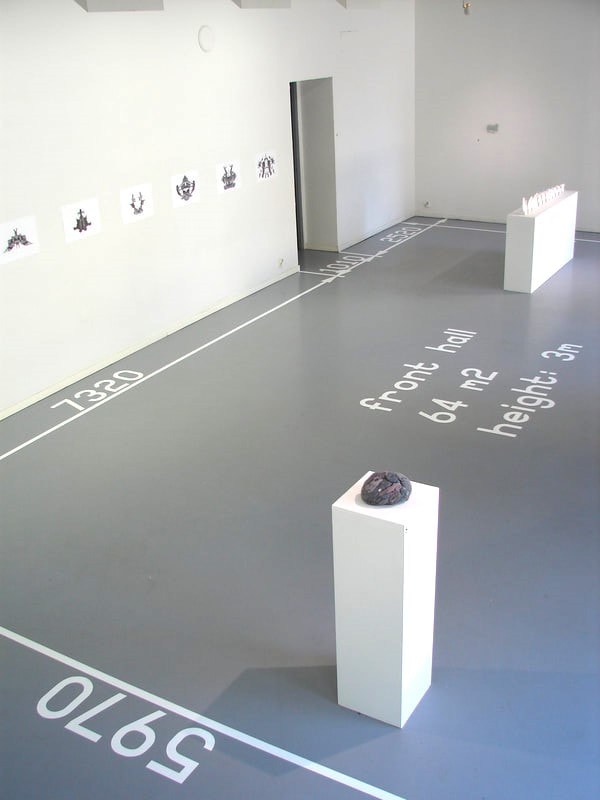

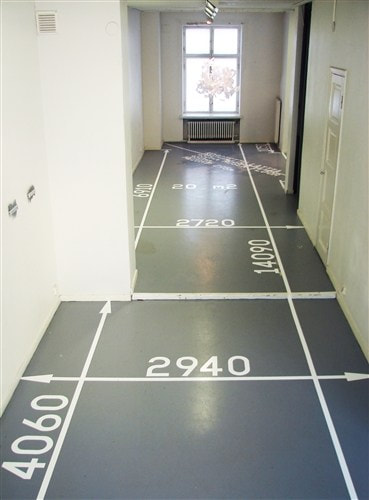

Floorplan proved to be something of a welcome departure from my usual modus operandi in that as due to its location I was unable to visit the gallery in advance; this lead to me having to establish my usual rapport with the space in a new and unexpectedly interesting way. My relationship with the gallery had to be garnered from photographs of previous exhibitions and a pdf copy of a floor plan of the building, all 2-dimensional sources; something that I had never done before and something that initially concerned me. I didn’t at first believe that I would develop the kind of intimacy with the space necessary to create a piece to work in harmony with it.
As it turned out nothing could have been further from the truth, I realised whist considering the distance, both physical and mental, between myself and the gallery that it was this very distance that was my fundamental relationship with it, the mental gap was bridged. I had been supplied with other people’s photographs and a plan drawn up by another person and they gave me an insight into the space and indeed the piece that I had not worked with before. In the end the floor plan of the gallery came to dominate my ideas, its flatness, it having travelled to me from somebody else these I realised were the qualities of the relationship that I wanted my piece to take to the exhibition.
As it turned out nothing could have been further from the truth, I realised whist considering the distance, both physical and mental, between myself and the gallery that it was this very distance that was my fundamental relationship with it, the mental gap was bridged. I had been supplied with other people’s photographs and a plan drawn up by another person and they gave me an insight into the space and indeed the piece that I had not worked with before. In the end the floor plan of the gallery came to dominate my ideas, its flatness, it having travelled to me from somebody else these I realised were the qualities of the relationship that I wanted my piece to take to the exhibition.