Atypical
Occupy Exhibition
Salford UK 2013
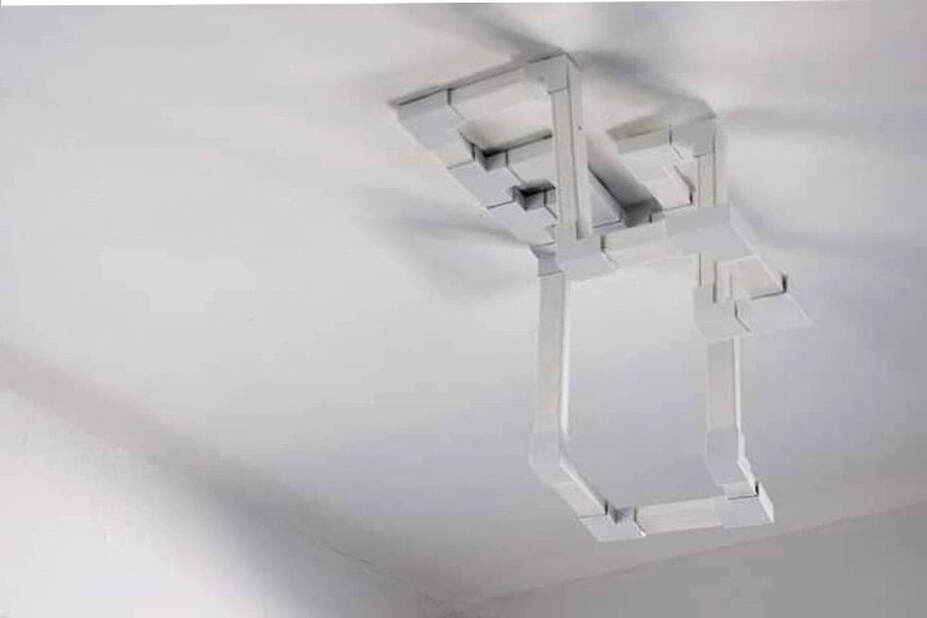
This iteration of the exhibition was staged within a 1960s concrete apartment block, a setting whose architectural character proved formative to the development of the piece. At some point after its construction, the building had undergone rewiring. Owing to the density of the concrete structure, the updated electrical system had been installed using surface-mounted plastic conduit. This pragmatic intervention, functional yet visually intrusive, became the conceptual point of departure for the work. The conduit traversed the apartment indiscriminately, tracing walls and skirting the junctions of ceiling and floor. Its routing appeared governed less by considered design than by expediency: the most direct path between two points prevailed, often without regard for visual coherence. In certain areas, the proliferation of trunking seemed excessive, even redundant, prompting me to reconsider it not merely as infrastructural necessity but as an inadvertent form of drawing in space.
Occupy Exhibition
Salford UK 2013
This iteration of the exhibition was staged within a 1960s concrete apartment block, a setting whose architectural character proved formative to the development of the piece. At some point after its construction, the building had undergone rewiring. Owing to the density of the concrete structure, the updated electrical system had been installed using surface-mounted plastic conduit. This pragmatic intervention, functional yet visually intrusive, became the conceptual point of departure for the work. The conduit traversed the apartment indiscriminately, tracing walls and skirting the junctions of ceiling and floor. Its routing appeared governed less by considered design than by expediency: the most direct path between two points prevailed, often without regard for visual coherence. In certain areas, the proliferation of trunking seemed excessive, even redundant, prompting me to reconsider it not merely as infrastructural necessity but as an inadvertent form of drawing in space.
|
The apparent superfluity of this system suggested both material and context for artistic intervention. I resolved to mimic the existing network, introducing additional sections of conduit configured in overtly impractical and illogical formations, loops, switchbacks, and diversions that denied any functional rationale. By amplifying the latent absurdity of the original installation, the work sought to foreground the tension between utility and excess, design and accident. |
The question of placement was critical. A survey of the apartment revealed that the only areas untouched by conduit were the centre of the floor and the centre of the ceiling. The former risked appearing as a conventional sculptural gesture; the latter’s, visual assertiveness was clearly the only real choice for such an chaotic deed. The ultimate siting of the intervention therefore required careful negotiation between integration and disruption, ensuring that the work remained embedded within the architectural logic it simultaneously subverted.
Ultimately, Atypical functioned as a critical amplification of the building’s own infrastructural language. By appropriating and exaggerating the grammar of surface-mounted conduit, the work blurred distinctions between necessity and ornament, sculpture and installation. Its ambiguity was not incidental but integral: positioned between object and environment, it invited viewers to reconsider the overlooked systems that structure domestic space, transforming utilitarian residue into a deliberate, self-reflexive spatial proposition.